
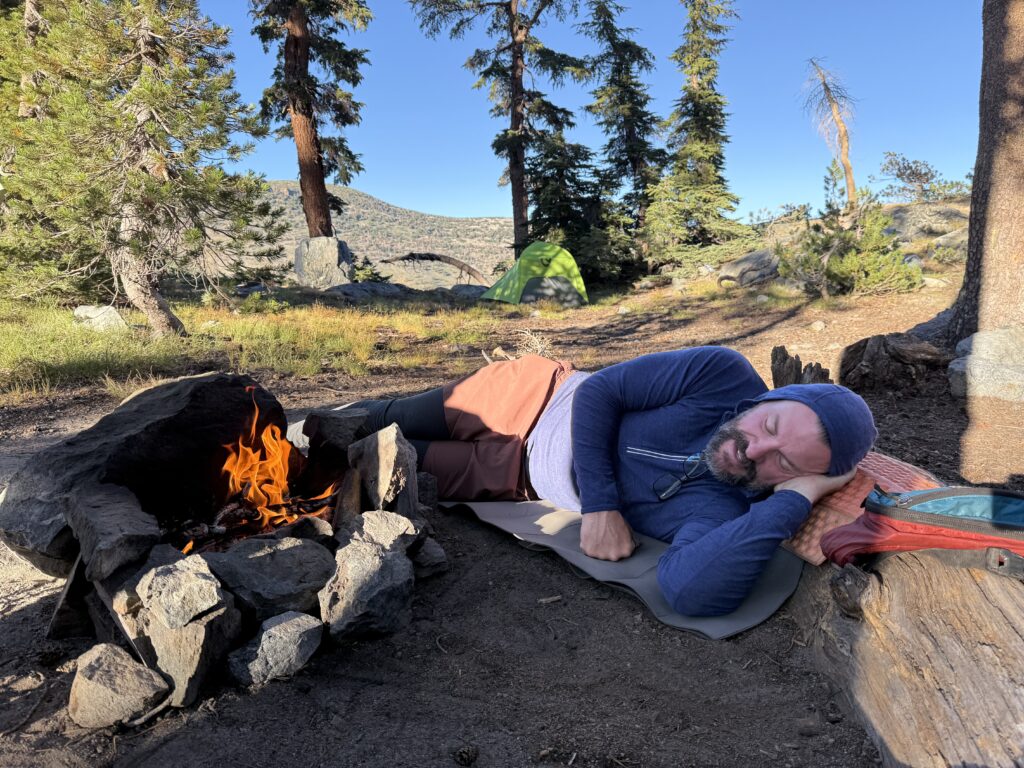
Backpacking clothing isn’t about fashion.
Think of your wilderness clothing as a technical uniform, just like the gear for any sport. A cyclist has a helmet and shoes that clip in. A football player wears pads. It’s not about fashion; it’s about high-performance equipment that’s built for a specific job. If it’s important to you, you can certainly shop for items that have an aesthetic that you like, but we highly recommend function over form when it comes to gear that you’ll be wearing for days on end.
In the Sierra, the primary job of your clothing is managing moisture and regulating your temperature.
The Job: Staying Dry and Regulating Temperature
Here’s the reality of a day in the mountains: you’ll spend two hours sweating on a long, uphill climb, then cool down fast when you stop for a break in the wind.
Your clothing system has to be able to handle both extremes. It needs to pull sweat off your skin when you’re working hard, keep you warm when you stop, and block the wind or a sudden rain shower. If the system fails, you get damp, then cold, then miserable.
The Core System: Active vs. Static
We divide the system into two parts: the “Active” layers you hike in, and the “Static” layers you carry for warmth when you stop or get to camp.
1. The Active System (What You Hike In)
This is your “daily uniform.” Its job is to manage sweat and protect you from the sun.
Hiking Shirt (1): One long-sleeve, synthetic sun shirt.
- Pro-Tip: Get a hooded one, and get the lightest color you can find (white is best). A white shirt is dramatically cooler in the sun than a dark one. My favorite shirt is the Outdoor Research Echo but if you want to be the coolest kid on the trail, check out Jollygear. There are many sun hoodies, my recommendation is to find one that’s very light, some of the materials on the heavier ones do not breathe well so they can get pretty swampy on a hot day.
Hiking Bottoms (1): One pair of synthetic shorts or lightweight pants.
- Pro-Tip: I use a variety of cheap shorts usually from Amazon or a local discount store like Marshall’s or Ross, but if you want to get fancy, brands like Lululemon sell some real nice ones.
Underwear (2 pairs): Synthetic or wool. You’ll alternate them. Shawna swears by her Paka merino underpants.
Active Mid-Layer (Fleece): This is your active warmth for hiking in cold conditions.
- What: A lightweight fleece jacket. Layers that use modern “active-insulation” like Polartec Alpha and Primaloft Active Evolve are fantastic choices.
- Pro-Tip: These fabrics look a little weird and fuzzy, you wouldn’t wear one to Starbucks and you might feel like you’re participating in Muppet Cosplay (I’m a Grover). But they are incredibly light and breathe better than anything else. Primaloft Active Evolve and Polartec Alpha Direct are the premier fabrics for this layer.
2. The Static System (What You Carry)
These layers live in your pack. Their job is to keep you warm and dry when you stop hiking.
Static Insulation (Puffy): This is your big-time warmth.
- What: A down or synthetic “puffy” jacket. This is non-negotiable. Down is a good choice here, and we’re not looking for a parka, just a lightweight puffy. Any jacket that’s ~12oz or less is a good choice. An 8oz puffy is considered exceptionally light, or 10oz with a hood.
- Pro-Tip: Buy this on sale from a site like Steep & Cheap. You are going to use this jacket. It will get dirty. It will get sap on it. You will probably get a small hole and patch it with Tenacious Tape. A patched, dirty puffy is a badge of honor, it says “I do cool stuff in this jacket.”
Camp & Sleep Layers (Long Underwear): This is your dry base layer for camp.
- What: One (1) pair of long-sleeve merino wool top & bottoms (like Smartwool 150).
- Pro-Tip: This is your base layer and your pajamas. You do not need dedicated “sleep clothes.” These layers must be kept dry, so you only put them on in the evening or in an emergency.
Shell Layer (Rain/Wind):
- What: We provide a full-coverage rain parka that goes over you and your pack. If you have your own high-end, lightweight rain gear, you are welcome to bring it instead.
3. Your Extremities (Feet & Head)
Head: Your choice. A mesh trucker hat is cheap and breathes well (you can use your sun-hoody). A wide-brim hat is also a great choice, and some people like a hat with a cape.
Feet (The Most Important Part):
- Shoes: We strongly recommend trail runners, not traditional boots.
- Socks (2 pairs): Wool. (Darn Tough or Smartwool).
- Pro-Tip #1: Buy two different weights or cuts (e.g., one “light” and one “mid-weight”). If you start to get a hotspot, switching to a sock that rubs in a slightly different way is a foot-saver.
- Pro-Tip #2: Alternate your socks each day (hiking in one, sleeping in the other) and swap them from foot to foot. A sock worn on your left foot one day should go on your right foot the next. This evens out the wear and prevents blisters.
The Cotton Problem: The Wrong Tool for the Job
This brings us to cotton.
This isn’t a rule or a judgment; it’s just a matter of physics. When cotton, like jeans, a hoodie, or a standard t-shirt,gets wet from sweat or rain, it does the exact opposite of what the system needs.
It stops insulating. It gets incredibly heavy. And it actively pulls heat from your body as it tries to dry.
We’re not gear snobs, we’re just practical. We’ve seen what happens when this system fails, and we’ve built our entire gear list around eliminating that hassle. Read about our weather strategy to understand why the right clothing matters. Using wool and synthetics instead of cotton is the single most important choice you can make to stay warm, safe, and comfortable.
(The only exception? A small cotton hanky for your nose. For that, it’s perfect.)
The “Optional” Items
Camp Shoes: Optional. Crocs or Birkenstock EVAs are popular and light. But here’s the test: If your hiking shoes are so uncomfortable that you need to take them off, you have the wrong hiking shoes.
Beanie / Gloves: A beanie is great for cool evenings. Gloves are personal preference, but pockets are lighter.
Camp Clothes: Optionally, you can bring a spare pair of shorts (especially if you brought pants to hike in) and a short sleeve shirt for camp. It’s nice to have something a bit lighter to wear at camp or if you want to wash your hiking clothes. This is not adherent to true ultralight principles, but for many people it’s worth the extra ounces. I often bring a lightweight short sleeve merino shirt to wear at camp.
That’s it. That is the entire system. Trust it. It’s light, safe, and it works. If you’ve signed up for a trip with us and you want to talk gear, just send us a message. Evan is an avowed Gear Nerd and loves talking about gear with people.
Ready to experience the Sierra with the right gear system?
Request a free consultation and we’ll send you our complete packing list after our call. Or learn what gear we provide so you know exactly what to bring.
