
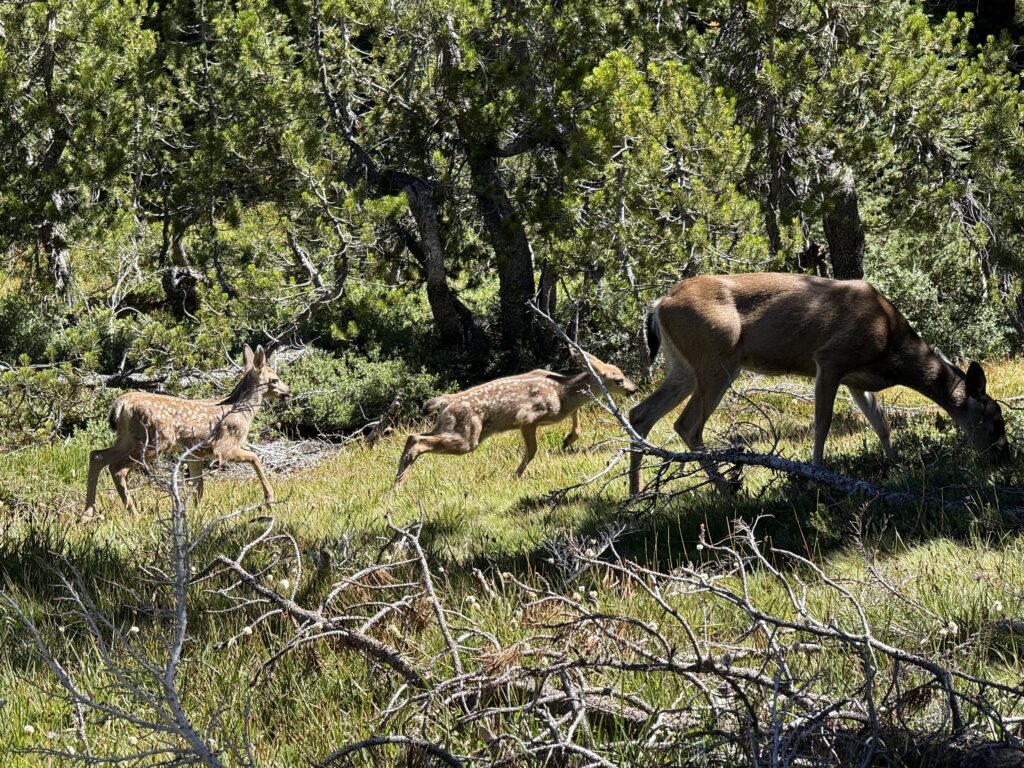
“What about bears?”
This is usually among the first questions we get. And it’s a good one. The idea of being in the deep wilderness with large animals brings up a lot of Hollywood-fueled imagery.
Here’s the honest truth: The single most important rule of traveling in Yosemite’s backcountry isn’t about protecting you from bears. It’s about protecting bears from you.
And the best part? It’s working.
The Big Misconception
Most people assume the regulations—the hard-sided bear canisters, the strict rules about “smellables”—are to keep people safe from aggressive bears.
They’re not. They are the tools of a massive, decades-long conservation success story.
It’s hard to imagine now, but in the 1960s and 70s, it was a form of evening entertainment for tourists to go to the Yosemite Valley dumps and watch the black bears feed on garbage. This practice taught bears one simple, dangerous lesson: People = Easy Food.
A bear that gets human food (a “fed bear”) eventually loses its natural, healthy fear of people. It becomes habituated and will seek out human contact for that food reward. This is how you get “problem bears” that raid campsites or, in rare cases, are relocated from towns like Mammoth deep into the backcountry. Tragically, a habituated bear that continues to seek out humans must often be put down.
The park’s solution was strict food-storage rules. The goal was to re-teach the bears that people are not a food source. By cutting off the supply, the park has helped an entire generation of black bears grow up wild.
The Yosemite black bear you might see today is the result of that success: an animal that is generally very skittish, avoids humans, and forages for its natural diet of berries, grubs, and plants. Our job is to keep it that way.
Our System: Boring, Practical, Effective
Bear safety isn’t a dramatic confrontation; it’s a matter of quiet, practical, and consistent camp discipline. We handle the systems so you don’t have to second-guess.
The “Pack It Out” Discipline
The most important rule is that everything you pack in, you must pack out. This is especially true for food. If you make a pot of chili and can only eat half, that other half of heavy, wet food goes into a Ziploc bag and into your pack. This is why our meal planning is so important, and why we work with you to plan meals you’ll actually want to eat, minimizing leftover food.
The Canister is Law
We provide all Park Service-approved bear canisters as part of our all-inclusive gear system. Everything that has a scent goes into these canisters. Not just your dinner, but your trail mix, your toothpaste, your sunscreen, your lip balm, and all your trash. No food, wrappers, or “smellables” ever get left in a tent.
The Clean Camp
When we wash dishes, it’s done at least 100 feet from our camp and any water source. The “grey water” from washing is poured into a small hole (like you’d dig for a bathroom break) and buried, so no scent or food scraps are left on the surface.
This simple, repeated routine makes our camp completely uninteresting to a bear. A bear that wanders by will find nothing, smell nothing, and keep moving. If it finds the bear canisters, which are not smell-proof, it will at worst play with it for a little while and then lose interest. It’s a boring non-event, and that’s exactly the goal.
What to Do If You See One
So, what happens if you do see a bear?
Honestly, 99% of the time, you’ll just see its backside. You’ll make a sound, it will hear you, and it will be gone before you can even get your camera out. We’ve seen it many times. They are truly more scared of you than you are of them.
But what if one is curious and wanders into camp, or you come around a bend in a trail and see one up ahead? The protocol is simple.
Don’t run. This can trigger a prey or chase response.
Don’t be quiet.
Do get big, stand tall with your group, and make noise.
The accepted method is to yell in a deep, firm voice, “Hey bear!” Clap your hands. Bang your trekking poles together.
This is called “hazing,” and it’s what park rangers do. You aren’t “antagonizing” the bear; you are actively reinforcing its natural fear of humans. You are reminding it that people are loud, annoying, and not a source of food. If the bear is persistent and doesn’t leave, the official NPS guidance is to throw small objects like pebbles or pinecones at it—not to injure it, but to annoy it.
(A quick and important note: Bear spray is not allowed in Yosemite. This hazing method is the correct and approved technique for black bears.)
You are, in that moment, helping to keep that bear wild.
The YWC Promise
Seeing a bear from a safe distance, watching it forage on a hillside, is an incredible experience that you will never forget, if you’re lucky enough to experience it. Our job is to make sure that’s all it is.
Bears aren’t a threat to be overcome; they are a wild success story to be respected and protected.
This is what we mean when we say we handle the complex logistics. We manage the gear, the permits, and the practical routines of bear-safe travel. You get to be fully present, confident that the systems are in place, and focus on the hike.
Ready to experience Yosemite’s wilderness with expert guidance?
Request a free consultation and we’ll plan your safe, bear-aware adventure. Or learn more about what we provide to keep you safe and comfortable in the backcountry.
