
(We’ll cover our recommendations for socks and foot care in a future post.)
Ask a traditionalist, or most people new to backpacking, and they’ll suggest you get a pair of “sturdy” hiking boots. You know the ones: all-leather, heavy, probably with red laces.
That is old-school advice.
After 15 years of guiding in the High Sierra, we can tell you that for the vast majority of people, this is a myth that can lead to a miserable trip. Those heavy boots are only necessary if you’re doing something highly technical, like strapping on rigid crampons for ice climbing.
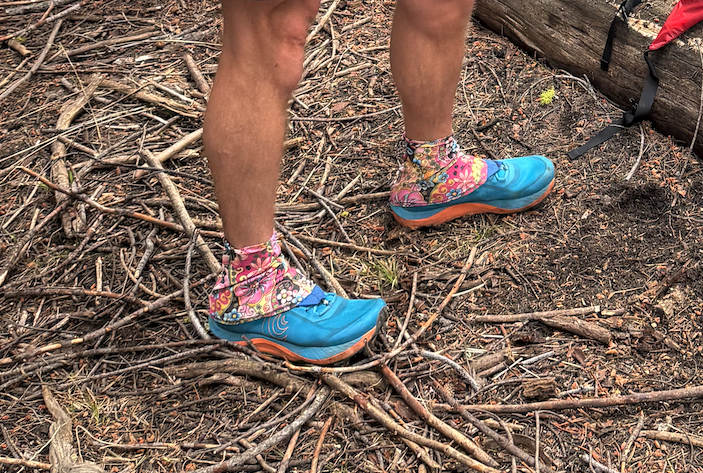
We generally recommend our clients wear high-quality trail runners.
Unless you have a specific ankle issue diagnosed by a podiatrist, trail runners are the way to go. This usually gets a few raised eyebrows. Here’s the practical breakdown.
The Myth of “Ankle Support”
The conventional wisdom is that a high-top boot prevents you from rolling your ankle. In our experience, this is a myth.
Your ankles roll when you get fatigued. I can tell you from experience: after 14 or 15 miles, my feet get less stable, and that’s when I start slipping off rocks. It’s straight-up fatigue, not the shoe.
What’s the biggest cause of fatigue? Weight.
There’s an old backpacking saying: “A pound on your foot equals five pounds on your back”. A pair of traditional boots can weigh 2 pounds per shoe, while a trail runner is closer to 9 ounces.
If your boots are just 2 pounds heavier than trail runners, that’s the equivalent of carrying 10 extra pounds on your back. All day. Every day. You wear heavy boots to prevent rolling your ankle, but they make you tired faster, which is what actually causes you to roll your ankle.
Less weight on your feet means less fatigue, better foot placement, and fewer rolled ankles. Agility is better ankle protection than a leather cuff.
What About the “Grey Area?” (The High-Ankle Hybrid)
In recent years, a new category of shoe has emerged: the high-ankle trail runner, like some of the boot models Hoka offers. A downside here is that many of these are offered in waterproof versions only, which we talk about later.
These are a fantastic “grey area” choice. They are built on a lightweight, cushioned running shoe platform but include a soft, high-cuff at the ankle. They don’t have the long break-in period or the heavy weight of a traditional leather boot.
If your primary goal is to have that extra “over-the-ankle” feeling of protection, a modern, lightweight boot like this is a great option that still avoids many the problems of old-school boots, though there is still a weight penalty vs a low top trail runner.
The Blister Problem: Break-in vs. Out-of-the-Box
Heavy leather boots require a long, painful “break-in” period. As you said, it’s an exercise in a bit of masochism.
Most people flying in for a 5-day trip don’t have time for that. If you show up with new boots, you are almost guaranteed to have a bad time. A blister can ruin a trip faster than anything else.
Trail runners are comfortable right out of the box. A properly-fit pair feels like slippers.
The “Waterproof” Myth: Why Dry Feet Are Better Than Wet Feet
Here’s the part most boot-sellers don’t tell you. Your feet will get wet. You’ll have a creek crossing, a sudden rainstorm, or just sweat.
- A heavy, “waterproof” boot, once it gets wet on the inside (from sweat or water over the top), will stay wet for days. That waterproof membrane works both ways: it prevents water from getting out just as much as it prevents it from getting in.
- A non-waterproof (mesh) trail runner gets soaked at a creek crossing… and is bone dry 30 minutes later from your body heat and the air.
We’ll take the fast-drying shoe every time.
“But What About My Heavy Pack?”
This is the main counter-argument, and it’s a valid one… for old-school packing. A heavy pack does require a stiffer shoe.
But on our trips, you are not carrying a 60 or 70-pound pack. You are carrying a professionally packed, modern, lightweight kit. Your pack will be 25, maybe 30 pounds at the very most.
You simply don’t need a heavy-duty boot for a modern, lightweight pack.
What We Mean By “Trail Runner”
To be clear, we’re not talking about road running shoes. A “trail runner” is a specific tool. It has a much more durable, aggressive sole for traction, and many include a “rock plate” in the midsole to prevent pointy rocks from stabbing you in the foot.
The honest downside? They wear out faster. You’ll get about 300 miles out of a pair, whereas a boot might last for years. But for our clients, who want the most comfortable, safe, and enjoyable 5-10 day trip, the trade-off is well worth it.
The goal is to enjoy the view, not to think about your feet. Trail runners are, by far, the most practical, comfortable, and safe tool for the job.
Ready to hike with lightweight, comfortable footwear?
Request a free consultation and we’ll talk through your footwear questions. Or see what gear we provide so you can pack light and hike comfortably.
